



Vietnam K-12 EdTech market is large enough to attract serious investment: 22 million students, a deeply ingrained culture of supplementary learning, and sustained public commitment to education technology.
But the gap between market potential and product-market fit remains wide. In 2026, three structural demand shifts are reshaping what this market actually needs: formalised AI education policy, expanding bilingual STEM programmes, and a move toward content-integrated language learning. This analysis from EdTech Agency breaks down what international operators need to understand before building or adapting products for the Vietnam K-12 market.
Vietnam K-12 Market Size and the Structural Gap Driving EdTech Demand
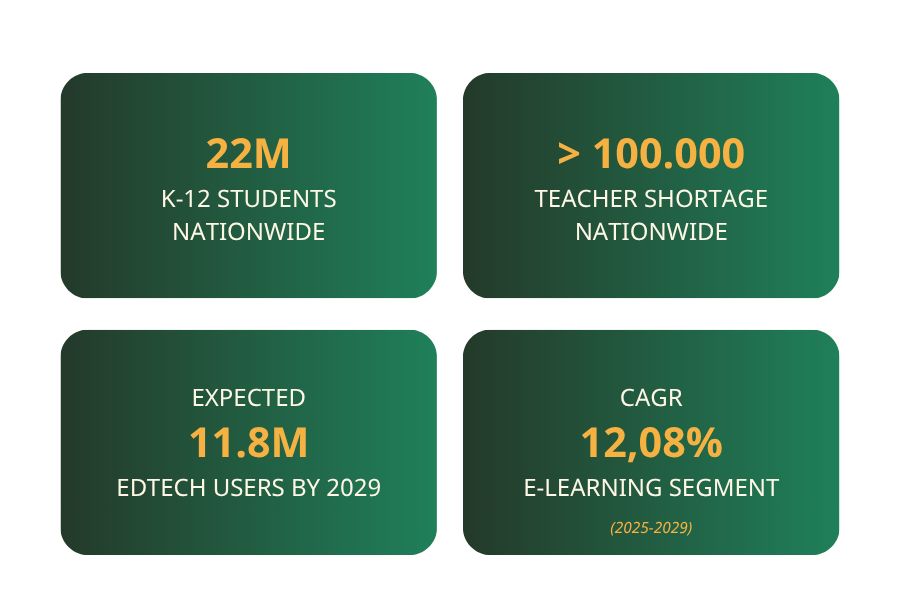
The teacher shortage of over 100,000 unfilled positions is the most consequential data point for international operators. This reflects a structural mismatch between student population growth and educator supply, not a temporary gap the system will close. It creates sustained, policy-independent demand for supplementary EdTech products that will remain a market feature for the foreseeable future.
Besides, supplementary learning outside school hours has become a near-universal behaviour across urban and rural Vietnam alike, making the B2C supplementary segment the broadest and most stable in the K-12 ecosystem though also the most competitive.
The B2B school licensing and hybrid (school + parent account) models are developing but remain significantly underserved relative to actual institutional demand. The barriers to entry are about curriculum alignment with the Ministry of Education, navigating the provincial Department of Education procurement process, and achieving genuine teacher adoption. These are execution variables that require on-the-ground market knowledge and, typically, a local partner or established ecosystem relationships.
A strategic variable that must be factored in now: the National Digital Learning Repository. The Ministry of Education is developing a national digital content repository aligned with the “Kết nối tri thức” (“Knowledge Connection”) unified textbook, with a pilot phase in 2026–2027 and nationwide rollout planned for 2028–2030. When complete, basic curriculum-aligned content will be available at zero or minimal cost. Products whose value proposition rests primarily on digitising textbook content, without a meaningful technology or experience layer above it, will face direct pricing pressure from a state-backed competitor from 2028 onward. The segments the national repository cannot address: genuine AI personalisation, teacher-support tooling, and skills outside the standard curriculum are precisely where commercial EdTech products should be positioned now.
STEM: From Policy Priority to Specific K-12 EdTech Product Demand
STEM education is now integrated across all levels of the Vietnamese school system, through classroom projects, extracurricular clubs, competitions, and innovation events. This is a formal component of the national education framework, creating systematic and recurring demand for EdTech STEM tools.
From the 2025–2026 academic year, Ho Chi Minh City is rolling out a bilingual STEM programme integrating English-language instruction with digital technology subjects, including coding, robotics, and foundational AI across 36 structured modules. HCMC consistently functions as the national pilot for education reform before models are scaled to other provinces, making this programme a reliable indicator of where the broader market is heading over the next two to three years.
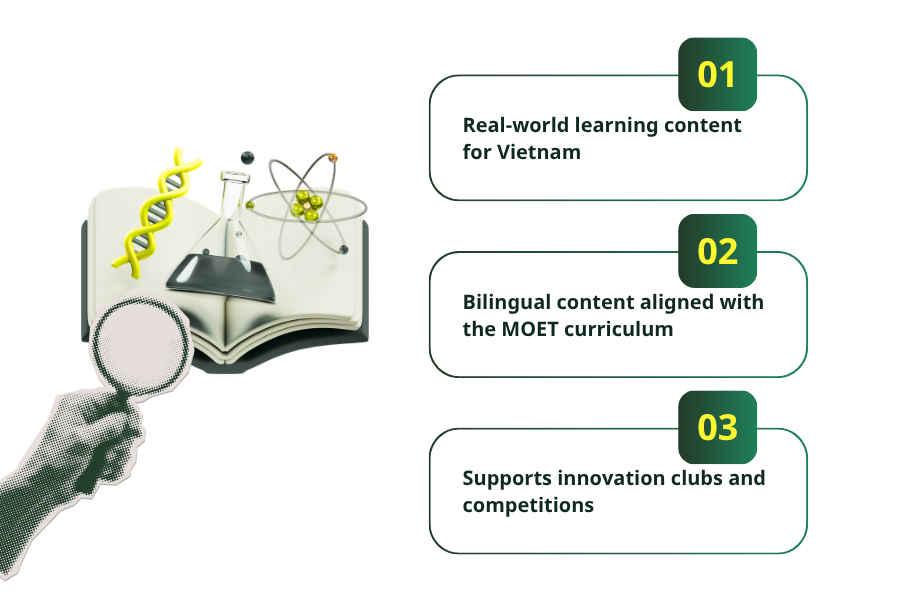
Product needs:
AI in K-12 EdTech Product: Policy Has Set the Direction
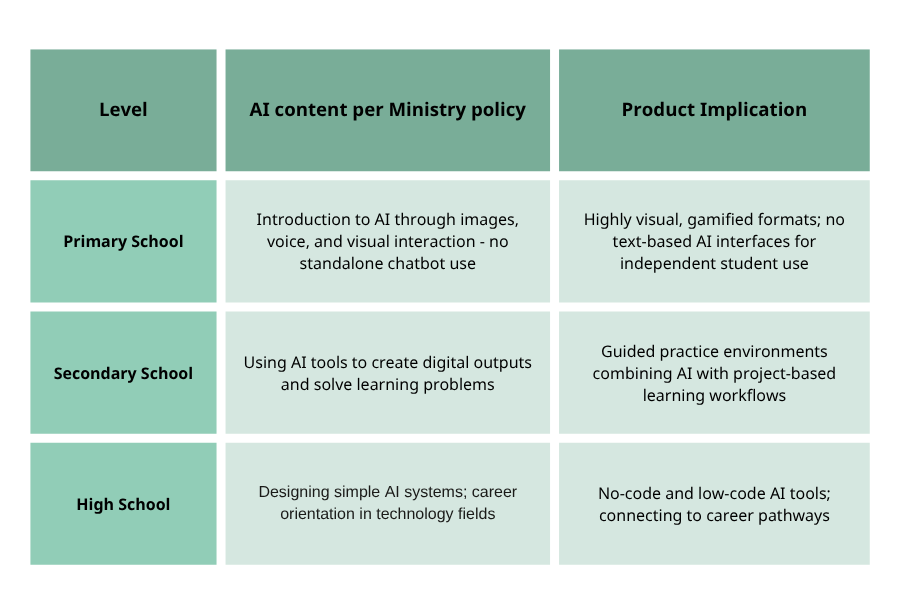
Ministry Decision 3439/QĐ-BGDĐT, issued in December 2025, formally embedded AI as a required component of the national school curriculum. This is the most consequential policy document shaping EdTech product demand for the 2026–2030 period.
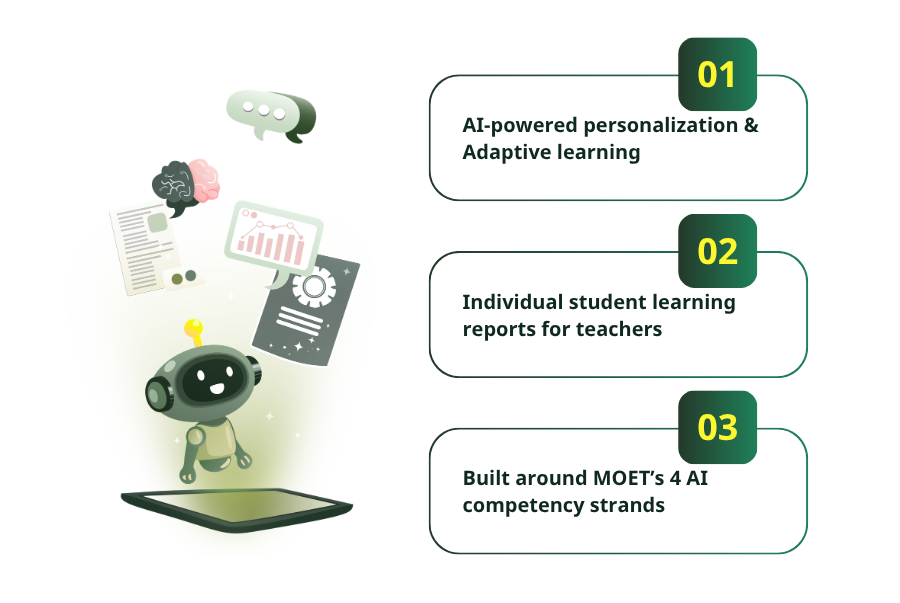
The Ministry’s AI competency framework is structured around four dimensions: human-centred thinking, AI ethics, AI application & technique, and AI system design. This framework signals clearly that the policy objective is not to produce AI engineers, but to equip students with adaptive capability and responsible technology use. EdTech products focused exclusively on technical coding instruction will not satisfy the full competency framework and are unlikely to pass institutional procurement evaluation on that basis alone.
From 2026, FPT Schools is deploying an AI-integrated Flipped Classroom model across more than 8,000 students. The key design insight: the AI does not function as a passive question-answering system, it proactively poses questions back to students, sustaining active interaction until the learner demonstrates mastery. This reflects the actual product gap in the market: demand is for tools that genuinely personalise learning pathways, not platforms that serve as passive content libraries.
Product needs:
Further Reading: Vietnam EdTech Market Q1/2026: Opportunities from the 174 Trillion VND Budget and M&A Trends
Language Learning: Expand From Primary School Through International Certification
Language learning is the largest and most competitive EdTech segment in Vietnam’s K-12 market. It is also the segment undergoing the fastest structural shift in the nature of demand that creates distinct opportunities for international operators who can navigate it correctly.
A critical framing note for market entrants: this is not one segment. It comprises two fundamentally different product problems — with different buyers, different willingness-to-pay dynamics, and different go-to-market requirements.
Sub-segment 1: English learning, primary through lower secondary – curriculum-aligned, household B2C
- In Hai Phong province, nearly 100% of primary schools have introduced English familiarisation programmes for Grade 1 and Grade 2 students, ahead of any mandatory requirement.
- The purchasing decision rests with parents, who typically prioritise curriculum alignment, age-appropriate design, and price accessibility.
- Willingness to pay in this segment is stable but price-sensitive, particularly as the rollout of free textbooks by 2030 may establish an expectation that digital learning materials should also be low-cost or free.
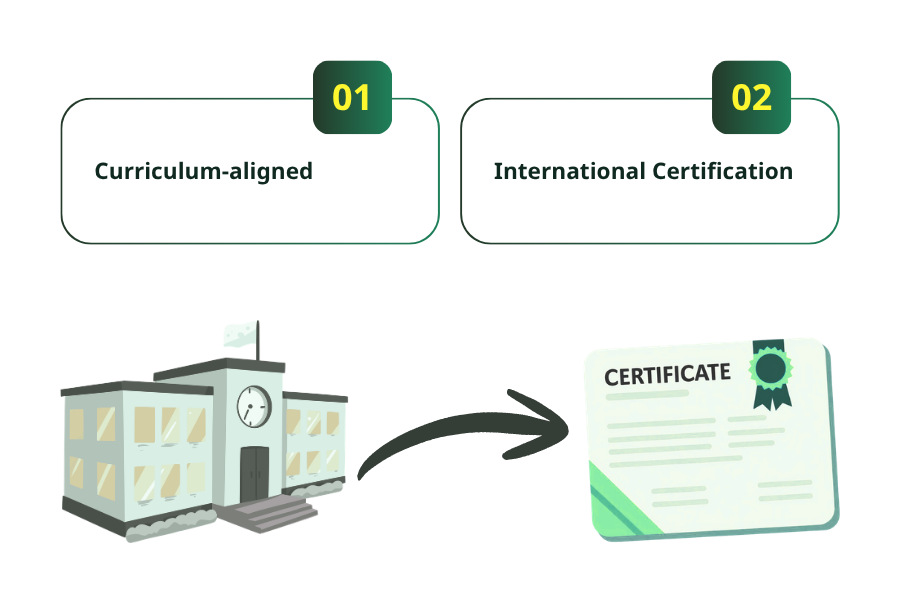
Sub-segment 2: International certification preparation, secondary and high school – higher willingness to pay, outcome-driven
- From the 2025–2026 academic year, Hong Quang Secondary School began piloting Mathematics and Chemistry instruction delivered in English, with plans to extend the model to additional subjects. This reflects a broader trend toward Content and Language Integrated Learning (CLIL) that is gaining traction in urban schools.
- Demand for IELTS and Cambridge examination preparation is present from lower secondary level upward.
- The purchasing decision involves both students and parents, and willingness to pay is materially higher, as outcomes are tied to specific goals: overseas study, selective school admission, or internationally recognised certification.
Product needs:
- English learning content structured tightly by grade level, not a single product attempting to serve the full K-12 range.
- Bilingual Vietnamese–English content for core subjects (Mathematics, Science) aligned with the Vietnamese national curriculum – a segment with few dedicated products currently.
- Content compatible with smart classroom infrastructure and interactive whiteboards — schools have invested in the hardware; the content to utilise it effectively is what is missing.
Four Core Product Requirements for the Vietnam K-12 EdTech Market in 2026
Across the segment analysis above, four product requirements emerge consistently as the areas where market demand is clearest and current supply is most insufficient.
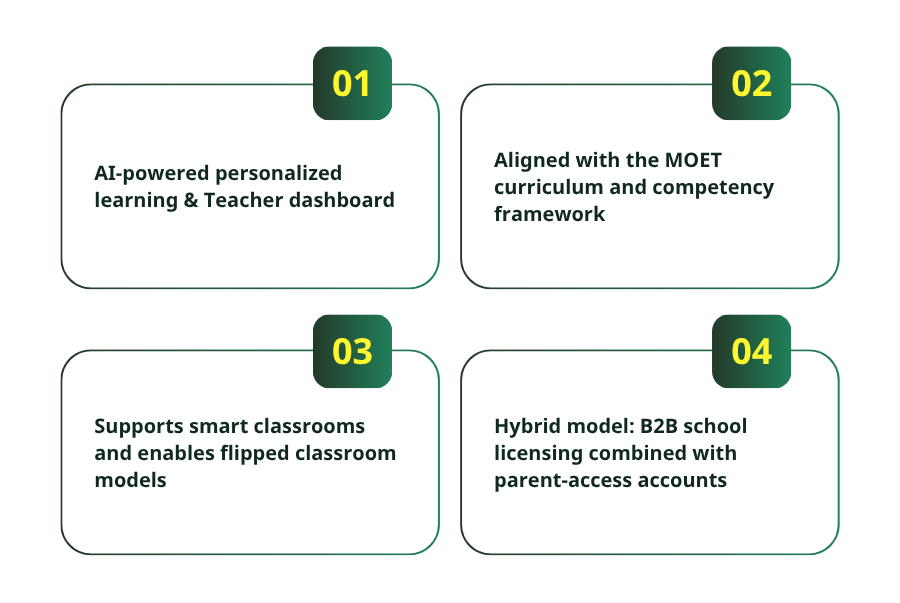
Genuine AI personalisation & Real-time teacher dashboard
AI as a marketing feature no longer convinces school procurement committees. The requirement is AI that substantively adjusts individual learning pathways and surfaces actionable data for teachers on an ongoing basis — not end-of-month reporting. This is the largest gap between what the market requires and what available products currently deliver.
Alignment with Ministry of Education curriculum and competency frameworks
This includes alignment with the “Kết nối tri thức” unified textbook (mandatory from the 2026–2027 academic year) and the four-dimension AI competency framework. Products that cannot demonstrate this alignment will not pass institutional evaluation for public school procurement, regardless of technical quality.
Smart classroom compatibility and flipped classroom support
Most schools in urban Vietnam have invested in smart classroom infrastructure: interactive whiteboards, multimedia rooms, networked learning environments. The content and tools to use this infrastructure effectively are what is missing. Products designed for this environment have a built-in distribution advantage in the B2B segment.
Hybrid model: B2S licensing + connected parent accounts
The most sustainable revenue architecture for the 2026–2030 period will combine institutional school deployment (B2B) with a connected household account layer (B2C), allowing parents to access and extend what their child is using in school. This model generates recurring revenue from both channels while reducing the customer acquisition cost for the consumer segment.
Building Your Vietnam EdTech Market Entry Strategy?
Edtech Agency works with international operators and investors to navigate the Vietnam market through primary data and on-the-ground execution knowledge:
- Segment targeting and product-market fit assessment
- Go-to-market planning
- Ecosystem introductions
Book a 1:1 Strategy Session with Our Founder here.