





The Vietnam EdTech market in 2026 is growing at a pace that places it in the global Top 10. Ho Chi Minh City is the country’s designated strategic market as the largest in learner population and public investment. Yet real-world data reveals a market where projected returns and operational risks coexist, driven by a structurally fragmented ecosystem. Edtech Agency breaks down the full picture of Ho Chi Minh City EdTech market based on the latest market research and analysis.
Vietnam EdTech Market Size 2026: Key Data Points
Vietnam currently ranks in the global Top 10 for EdTech growth speed and Top 3 most promising EdTech markets in Southeast Asia.
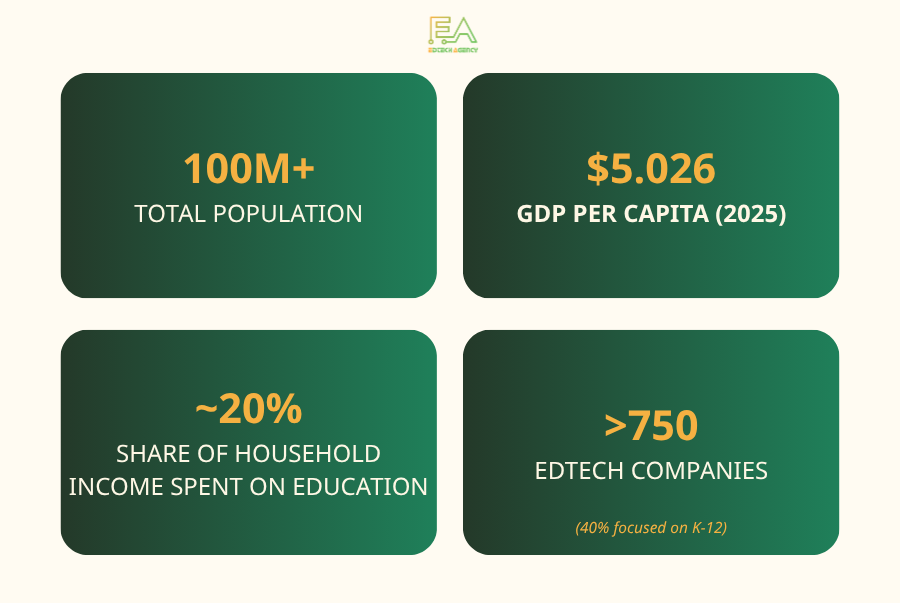
With 25 million K-12 students and average annual spend of $700–$1,000 per student (of which ~$300 comes from household budgets), the private EdTech market in Vietnam holds significant commercial potential.
However, of the 750+ companies, only around 300 apply technology at a high level – the remainder operate at a basic technology level.
Vietnam’s EdTech market in 2026 is large in volume, but ecosystem quality has yet to match that scale. This represents both a risk and a major opportunity for operators who understand the market and position themselves accordingly.
Which Segments are leading on AI adoption?
Language learning is the segment leading AI adoption. Platforms including ELSA, Duolingo, Monkey, and Yola are deploying AI for personalized learning pathways and real-time pronunciation assessment.
Online testing and assessment platforms rank second. Blockchain is being piloted at the Ministry level for credential and certificate verification – a problem specific to the Vietnamese market context.
Corporate and workforce training currently has the lowest competitive density relative to the actual scale of demand.
Macro Context and Strategic Outlook for HCMC EdTech 2026–2030
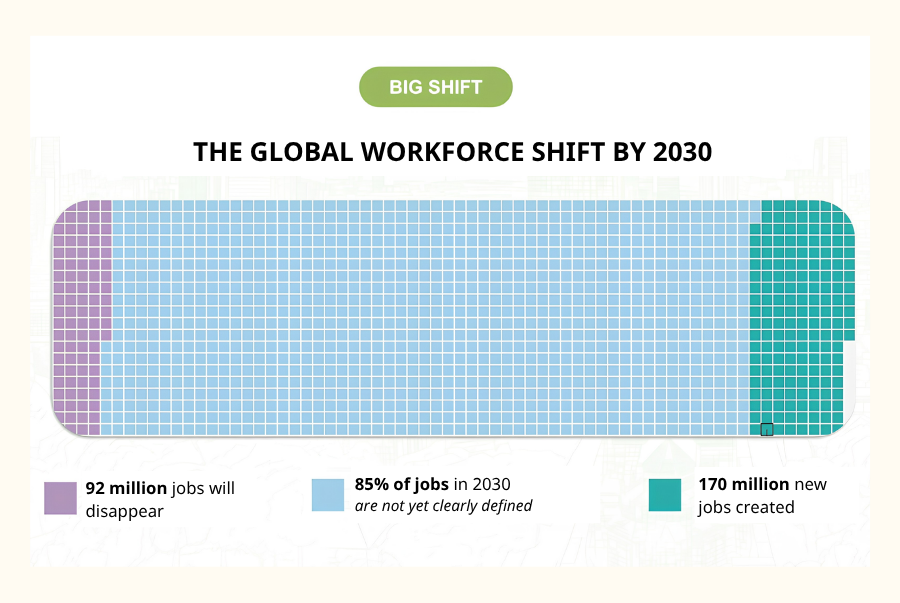
The opportunities and risks of the Ho Chi Minh City EdTech market are shaped by several major global shifts:
- Labour market displacement: By 2030, 85% of jobs currently in existence will either have disappeared or not yet be clearly defined. The demand for new skill development is the long-term growth variable for the sector.
- Labour structure within education: The share of education tasks performed by humans is projected to fall from 57% today to 39% by 2030, driven by AI adoption.
- Local digital readiness: ~85% of HCMC’s workforce has digital skills and is ready to adopt new technology and AI – a critical indicator that allows companies to reduce user onboarding costs significantly.
- Strategic ambition: HCMC is targeting a place in the Top 100 global startup ecosystems by 2025–2030, positioning itself as the region’s innovation hub.
The Risk of “Systematic Fragmentation”
Despite its scale, research from Edtech Agency highlights the operational risks that EdTech companies most commonly encounter in this market.
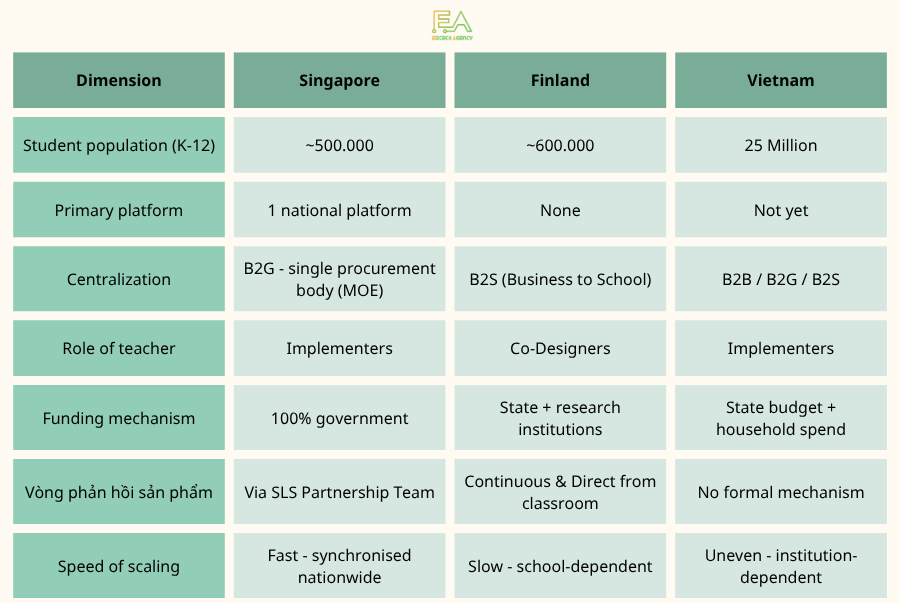
The following benchmark compares the operating models of Singapore (SLS), Finland (Helsinki Education Hub), and Vietnam today.
Ho Chi Minh City EdTech Market: Blue Ocean or Red Hot Competition?
The opportunity coordinates: Infrastructure and Budget data
1. Largest K-12 market in Vietnam
- K-12 students: ~2.6 million
- Schools: ~3,500
- Teachers: 110,000+
2. Fast and sustained demand growth
- New students (2025-2026): ~40,000
- Trajectory: Sustained medium-term growth
3. Dense innovation ecosystem
- Universities: 40+
- Innovation centres: 80+
- Data centres: 16
4. Strong public financial commitment
- Education budget (2021-2024): ~VND 76,600B
- Share of city budget: Min. 20%
Barriers to EdTech deployment in HCMC
1. Too many products, too little integration
The market has an abundance of startups and genuine demand, but lacks shared integration infrastructure and coordinating mechanisms.
2. Gap in AI deployment
Teachers are primarily end-users, not co-designers, meaning products rarely reflect the realities of actual classroom practice.
3. Fragmented pilots
EdTech and AI activity in schools is dispersed and unstandardised with no common framework, making scale-up structurally difficult.
Reading the data: HCMC as a market
High Potential: For solutions with genuine integration capability, standardization, and the ability to build co-design relationships with schools through direct data–feedback loops.
High Risk: For standalone products entering via traditional product-demonstration sales, without a clear ecosystem strategy.
What determines competitive positioning in HCMC in 2026 is the ability to shift from “selling a product” to “co-designing an ecosystem.”
Are You Building a Ho Chi Minh City EdTech Strategy for 2026–2030?
Book a 1:1 Strategy Session with Our Founder here:
- 30-minute focused session
- Go-to-market strategy
- Product-market fit assessment
- EdTech ecosystem connections
Edtech Agency helps executives and international investors decode the Vietnam market through real execution data. We help you define your target segment, optimize your market entry roadmap, and build durable competitive advantage.