




The Vietnam EdTech market Q1/2026 is navigating a complex intersection of macroeconomic pressures and long-term strategic opportunities. While geopolitical shifts and rising operational costs are creating short-term headwinds, the market remains anchored by national digital transformation mandates, robust FDI, and a massive public budget. For international EdTech executives, understanding the Ministry of Education and Training’s (MoET) actual budget reallocations is essential for crafting a high-impact market entry strategy.
This report provides an executive deep dive into capital flows, emerging financial models, and a detailed analysis of public spending to help leaders optimize their expansion into the Vietnamese market.
Geopolitical Landscape and Its Impact on Vietnam EdTech Market Q1/2026
Two critical factors are currently impacting profit margins and user acquisition costs: hardware logistics and technical infrastructure.
Supply Chain Disruptions and Hardware Inflation
The global semiconductor crunch has pushed hardware production costs to new heights. Projections for 2026 indicate that smartphone and PC prices will rise significantly, by 14% to 20%.
Since the Vietnamese EdTech market is heavily dependent on personal devices for remote learning, this poses a substantial barrier. Public school procurement projects may face budgetary constraints, and household spending on educational technology is likely to be scrutinized more closely.
Operational Pressure from Rising Energy Costs
With Brent crude exceeding $100 per barrel, the cost of maintaining servers, data centers, and cloud computing services is escalating. B2B EdTech providers particularly those offering LMS or school management software are under pressure to raise service fees.
In a price-sensitive market like Vietnam, price hikes can hinder mass adoption. Executives should prioritize optimizing software architecture to reduce resource consumption rather than relying solely on price adjustments.
Long-term Outlook
Despite immediate cost pressures, the market scale for Q1/2026 remains highly promising. The fundamental demand for education and national digital policies will continue to drive the growth of online learning platforms, language apps, and educational administration software.
Further Reading: Vietnam EdTech Market Size 2026: Is Ho Chi Minh City a High-Growth Opportunity or a High-Risk Bet?
Investment Climate and M&A Selectivity in Q1/2026
Investment data for Vietnam’s education sector in Q1/2026 reveals a significant shift in capital behavior:
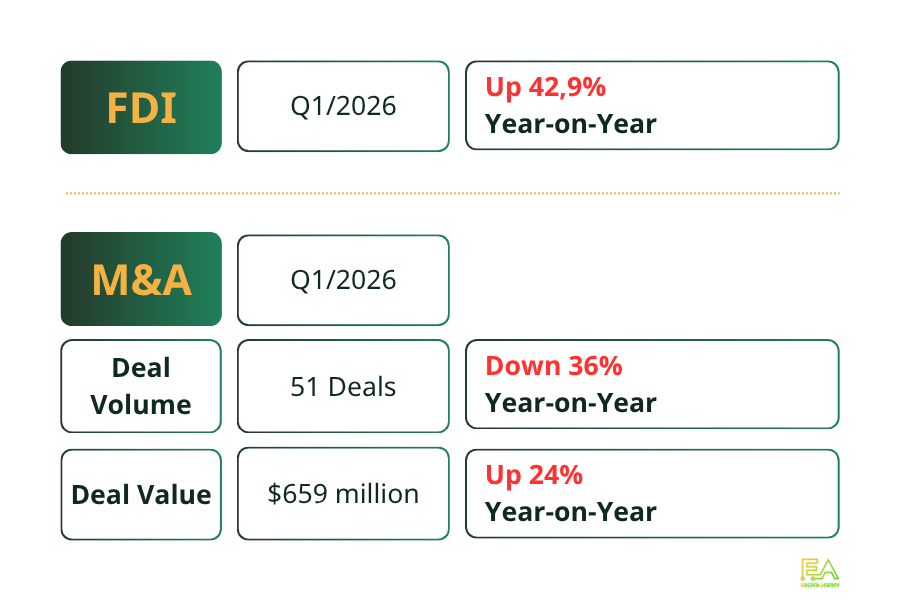
- Strategic Consolidation: Capital is now concentrating on high-value, high-quality deals with long-term strategic potential, rather than being spread across numerous small-scale startups.
- FDI Momentum: A resurgence in FDI is boosting investor confidence, encouraging foreign capital to flow into high-potential sectors like education.
Public Investment in Vietnam Education: Long-term Roadmap and Real-world Allocation
Public Investment in Vietnam’s Education and Training in Q1/2026 is defined by two primary sources: the Long-term National Target Program and direct investment from MoET.
The Long-term Public Investment (2026-2035)
The National Assembly officially passed Resolution No. 249/2025/QH15, approving the “National Target Program on Modernizing and Enhancing Education and Training Quality for 2026–2035.”
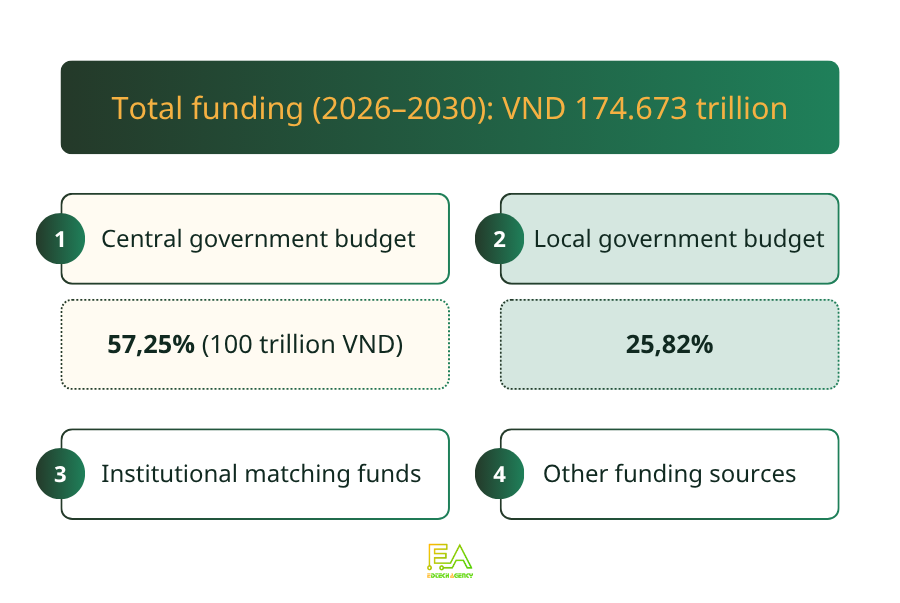
This 174 trillion VND package serves as the backbone for upgrading infrastructure and educational standards nationwide over the next decade.
Direct Public Investment from MoET in Q1/2026
According to Decision 370/QD-BGDDT, the Ministry of Education is prioritizing central budget funds for the infrastructure of key institutions. A prime example is the technical infrastructure project for the University of Da Nang (Hoa Quy – Dien Ngoc site), which utilizes both domestic capital and World Bank (ODA) loans.
Key Strategic Observations from MoET’s Q1/2026 Decisions:
- Focus on Hub Excellence: The budget is being funneled into building international-standard “Regional Universities” and “University Cities” in Central Vietnam, rather than fragmented spending.
- Leveraging International Capital (ODA): The active mobilization of World Bank loans signals a high demand for infrastructure upgrades that meet international standards, creating a massive window for global tech providers.
- Agile Disbursement Discipline: Only one month after disbursement under Decision 370, MoET issued Decision No. 502/QĐ-BGDĐT, cutting VND 34,205 million from the 2026 capital plan for selected University of Danang projects to align with implementation progress.
Budget allocation in Vietnam is no longer “set in stone.” The Ministry is increasingly disciplined, ready to claw back or reallocate funds if projects stall. EdTech vendors must demonstrate high execution capacity to remain viable partners in these public projects.
4. Innovative Financial Models in the Private Sector
Parallel to public funding, the private sector is introducing creative financial solutions to address rising costs for learners.

Strategic partnerships between commercial banks and international school systems are creating optimized financial packages.
- Mechanism: These models allow families to leverage existing capital (e.g., using interest from savings to pay tuition directly).
- Dual Benefits:
- For Parents: Ensures a long-term, stable educational path for children without the pressure of tuition hikes or short-term economic volatility.
- For Schools: Ensure stable funding and predictable cash flow, allowing institutions to focus on operations and reinvestment into educational technology and facilities.
Beyond supporting parents, the rise of these models contribute to a more predictable environment for EdTech providers engaging with private schools.
Unlock Deeper Insights into the Vietnam EdTech Market
To further discuss the data in this report or to explore networking opportunities within the Vietnamese EdTech ecosystem, contact Edtech Agency.
Edtech Agency supports international executives and investors in decoding the Vietnamese market through real-world execution data. We help you identify target segments, optimize your entry roadmap, and build a sustainable competitive advantage.
🤝 30-MINUTE 1:1 STRATEGIC CONSULTATION WITH OUR FOUNDER
Focus Areas:
- Go-to-Market Strategy analysis.
- Product-Market Fit assessment for Vietnam.
- Ecosystem Connectivity with local partners.
Book your consultation here.